
Per public reports, the United States is low on interceptors and long-range munitions to the point that it can no longer continue the war against Iran with the previous strategy. There are other ways to reopen the Strait of Hormuz militarily, but that does not change the fact that we are dangerously low. There are two questions now: 1. Are the leaks treasonous? 2. How did we get here?
First, these leaks simply confirm what defense experts have been warning about. The Center for Strategic and International Studies published a report on April 21, warning that the United States had depleted more than half of some types of munitions. Here are the munitions we are running low of, according to the study by the Center for Strategic and International Studies.
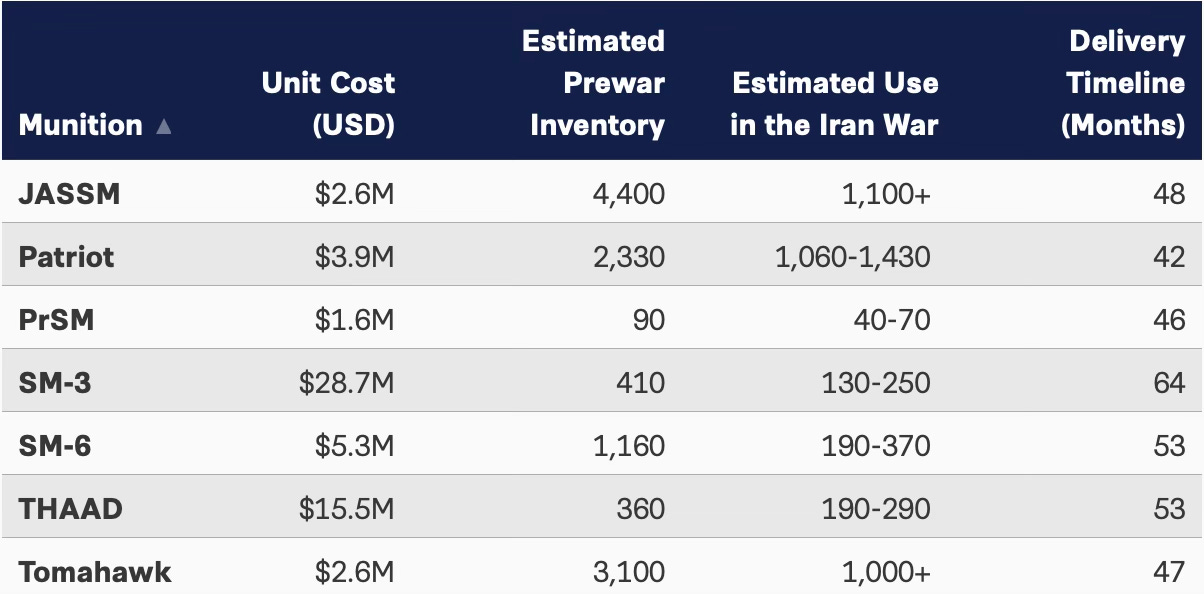
The Congressional Commission on National Defense Strategy published in its 2024 report that the United States was low on munitions, and restocking them would take enormous effort and time.
It is also not difficult, even for the layperson, to figure this out. Congress appropriates a budget every year, and it specifies money for each item. How much each unit approximately costs is a matter of public record, too. And then, the Central Command publishes statements about how many units it has depleted. All you need is to go back through each year’s budgets to see how many units of each munition type the U.S. government bought over the years, and how many it has depleted. You will have a reasonable estimate of how many we have left.
Journalists did not know about this because it was too much to ask of them to investigate a critical national security issue, rather than tweeting about President Donald Trump’s tweets. But Iran did its homework. It is not a coincidence that Iran’s whole strategy has been producing a lot of cheap missiles and drones until we run out of interceptors, so that they could then hit their targets. Which is how it ended up working.
How did we get here? It is not any one person’s fault, including Trump. This problem goes back decades. The first sin was when Bill Clinton’s Department of Defense told major defense contractors that they should go out of business because the Cold War was over. So all the major contractors merged, and the number went from 51 down to 5. As a result, each contractor today can just jack up the prices because the competition is so limited. To be fair to Clinton—something I do my best to avoid normally—no president after him tried to undo this, either.
The second problem is with the Pentagon. The Pentagon loves the most advanced tech, which is expensive. But as Ukraine and Iran have shown, you can also conduct a successful war with a lot of cheap stuff. Pentagon preferred a few awesome stuff, which we ran out of quickly. This includes the Pentagon bureaucracy and all the secretaries of defense who never told the bureaucracy to stop. Worse, most of them cheered it on.
Let me give you a few examples. In Fiscal Year 2025, Congress appropriated $405 million for Patriots and about $500 million for SM-3s. So we got 100 Patriots 17 SM-3s. We depleted a decade of each system’s production in six weeks to shoot down missiles and drones that cost a few thousand dollars per unit. I mean, even if money did grow on trees, that still would be too much!
Interceptors and even certain offensive munitions were first meant to be for specific operations, so that ground units could advance without being bombarded by enemy artillery. The problem is that, instead of being air defense for a larger strategy, the interceptors have nearly become the whole strategy.
The third offender is Congress. Successive sessions of Congress have voted for this. At the end of the day, Congress has the power of the purse, which means that it is ultimately Congress, not the Pentagon, that determines U.S. national defense strategy. The most the Pentagon can do is to recommend a budget and argue before Congress for its strategy, but the decision, ultimately, rests with Congress. But too many members of Congress are busy doing television hits instead of doing less important things like examining our military doctrine and holding the Pentagon accountable.
The United States has a dual political authority system: Both Congress and the president are the bosses of the military. During the Civil War, General Ulysses Grant was caught between Congress and President Lincoln, who were making opposite demands. He sided with Lincoln. Then, after the war, he was again caught between Congress and, this time, President Andrew Johnson, making opposite demands. This time, he sided with Congress. There was a simple reason: In wartime, the president gets the tiebreaker, and, in peacetime, Congress does.
We have been at peace for a long time, which means that Congress should have been the supreme voice in national defense. But it has not been. We are here because consecutive presidents, secretaries of defense, and Pentagon bureaucracy had the wrong idea for war fighting and acquisition, stuck in group thinking. But they got their way because nobody in Congress raised their hands and said they were being silly.
The only way to get out of this problem is for Congress to once again take its job seriously. The Constitution makes providing for national defense the primary role of the federal government, and it makes Congress the Article 1 branch. This means that Congress is the foremost party responsible for national defense. But the truth is that Congress has spent trillions of dollars and let the American people down by not second-guessing what it was being fed.
Does Trump bear the blame? Yes, as much as his predecessors over the past several decades, and he shares it with secretaries of defense over the same period. But he deserves much less blame than members of Congress who wrote the check. And now, they ought to write more checks to fix it. But they better do it soon, or we might as well save ourselves the trouble of losing a war and just offer the world to China on a silver plate.