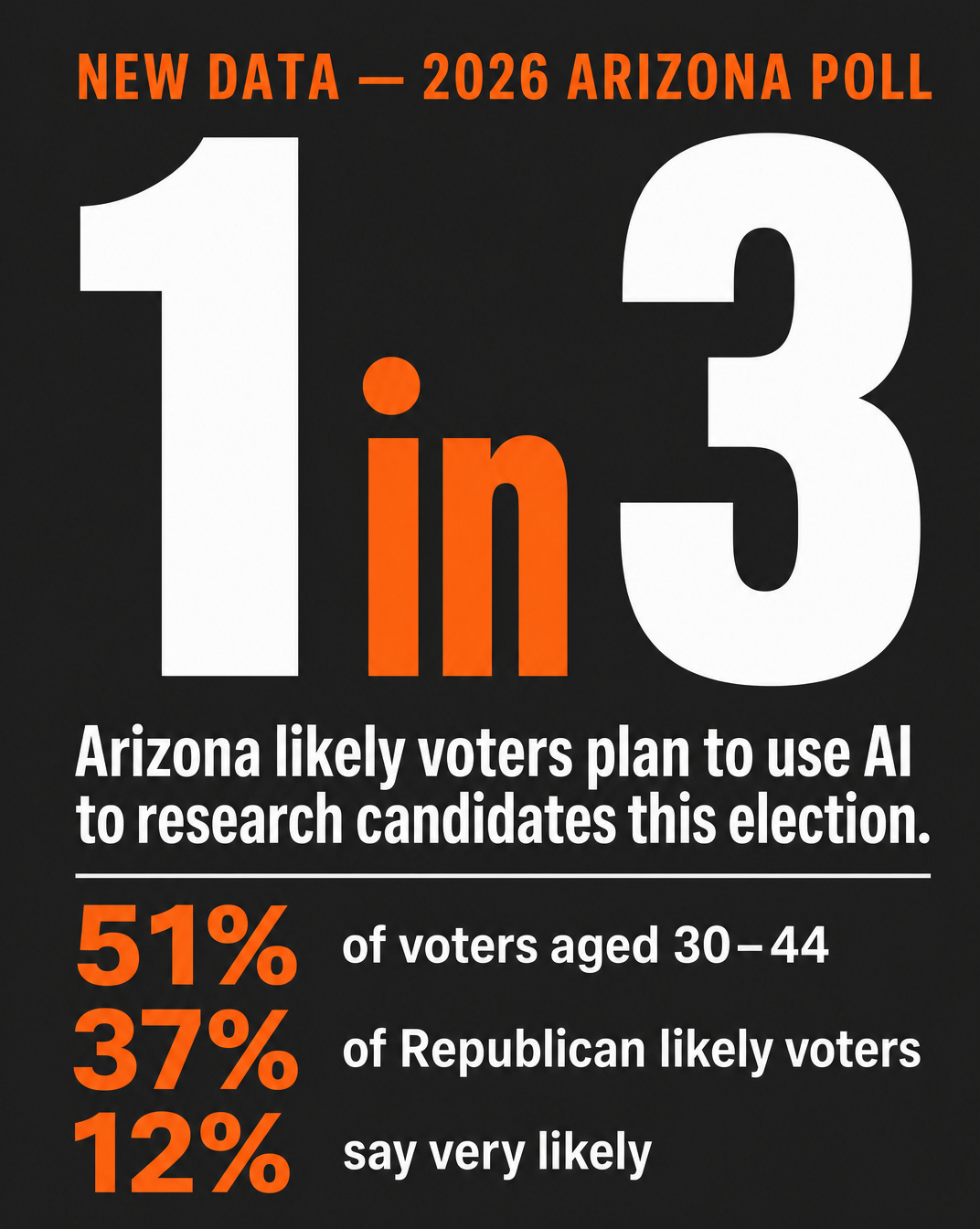
We asked 897 Arizona likely voters a simple question: How likely are you to use artificial intelligence tools, like ChatGPT, to research candidates and issues before voting this year?
One in three voters said likely.
Among voters aged 30 to 44, it was one in two.
Among Republican likely voters, it was 37%.
This is not a hypothetical. It is happening right now, in this election cycle, in Arizona, and campaigns rarely have a strategy for it.
But here is the part most campaigns are missing entirely: that 33 percent is almost certainly an undercount.
———
THE REAL NUMBER IS MUCH HIGHER THAN 33 PERCENT
Our poll question asked voters whether they would actively choose to use AI tools to research candidates. But that framing understates the problem dramatically, because most voters who encounter AI-generated information about candidates never made a conscious choice to do so.
When a voter Googles a candidate’s name today, the first thing they see is not a list of links. It is a Google Gemini AI overview sitting above every result on the page. They did not ask for it. They did not opt in. They simply searched, and AI answered first.
When a voter reads their email on an iPhone or an Android, Apple Intelligence or Google’s AI features have already summarized the key points before they even open the message. When they scroll through news on their phone, AI-curated feeds are selecting what they see. When they ask Siri or Google Assistant a quick question about a candidate on their way to the polls, they are getting an AI-generated response - whether they know it or not.
The 33% of voters who say they plan to actively use ChatGPT or similar tools are the tip of the iceberg. AI is now embedded in every channel through which voters encounter information.
The question is not whether AI will shape what voters think about your candidate. It already is. The question is whether your campaign shaped the information AI is working from.
———
THE PROBLEM WITH HOW AI ANSWERS POLITICAL QUESTIONS
Voters who turn to AI for candidate research are not getting a search results page. They are getting a synthesized answer.
Here is what campaigns need to understand: LLMs do not reflect truth. They reflect the information ecosystem. Whatever is most indexed, most cited, and most structurally accessible online is what the AI returns - regardless of whether it is accurate, complete, or favorable to your candidate.
When a voter asks ChatGPT “which candidate has better experience,” the model is not consulting a database of verified facts. It is pulling from a hierarchy of sources: Wikipedia first, then Ballotpedia, then high-authority news coverage, then the candidate’s own website, and synthesizing whatever narrative those sources have built. If that narrative is incomplete, outdated, or dominated by negative coverage, that is what the voter hears.
———
HOW AI DECIDES WHAT TO SAY ABOUT YOUR CANDIDATE
When a voter asks ChatGPT about a candidate, the model pulls from a clear source hierarchy:
Wikipedia sits at the top. Studies show Wikipedia content is cited in anywhere from one-fifth to two-thirds of all AI responses on political topics. In a controlled experiment published by FWIW News, ChatGPT included new Wikipedia content verbatim in its responses within twelve minutes of publication. Whatever your candidate’s Wikipedia page says (or does not say) is likely the first thing AI tells voters.
The campaigns that understand this architecture will own the AI-generated narrative in their race. The ones that do not will discover too late that the internet wrote the story for them.
———
WHAT THIS LOOKS LIKE IN A REAL RACE
Consider two candidates running in the same primary. Candidate A spent twenty years in the private sector building businesses, creating jobs, and solving real problems with measurable results. By almost any objective standard, their real-world experience makes them the stronger choice for the office they are seeking. Candidate B is a career politician. They have held office, run before, and accumulated a long public record, but their actual accomplishments are thin.
Ask ChatGPT who has more experience.
In most cases, the AI will favor Candidate B, not because it evaluated their records, but because Candidate B has more of a digital footprint. More Wikipedia entries. More Ballotpedia mentions. More news articles stretching back years. The career politician has a history the internet can find. The private sector candidate has a career that the internet has never documented.
This is the core problem. AI does not measure quality of experience. It measures the volume and accessibility of information. A candidate who spent two decades closing deals, running payroll, and building something real in the private sector may be vastly more qualified, but if that career is not structured and indexed in the sources AI trusts, the AI will not know it exists.
The result is that voters asking ChatGPT “who has more experience” get an answer that reflects whoever invested in their digital pr
esence, not whoever actually has the stronger record.
The AI is not lying. It is telling the story the internet gave it. And 33% of Arizona likely voters are reading that story.
The campaigns that understand this and act now are the ones that control the answer.
———
Polling was conducted by Noble Predictive Insights May 5–7, 2026, surveying 897 Arizona likely voters with a margin of error of ±3.27 percent.