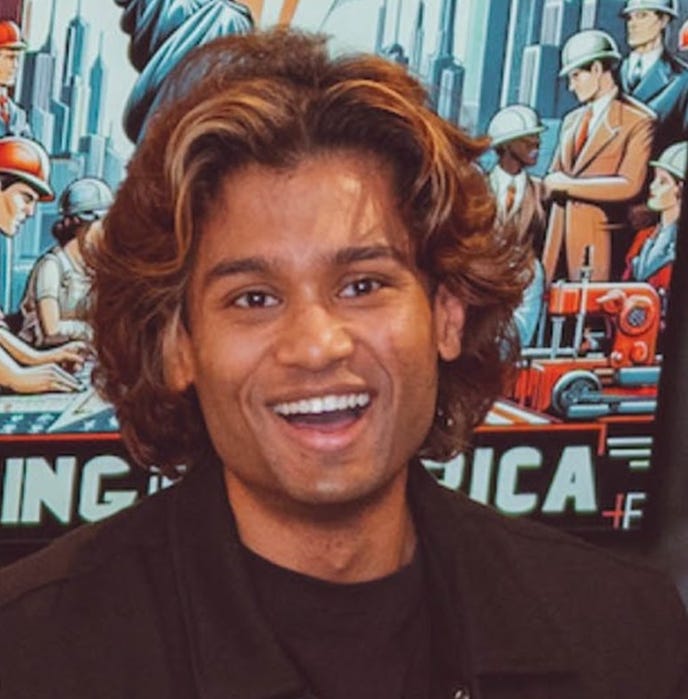
Few topics ignite debate like immigration and identity, which is why hosts Chuck Warren and Sam Stone invited Sagnik Basu to Breaking Battlegrounds to unpack his viral Pirate Wires essay, “I’m Sorry, But You Have to Assimilate.”
Basu, who grew up in the U.K. before moving to the United States a decade ago, has worked across both legacy outlets like Fox News and independent media. His experiences in politics, journalism, and traveling outside coastal bubbles gave him a unique lens on what it means to be an immigrant in America today.
He explained that much of the mainstream media operates in echo chambers—New York, D.C., and Hollywood insiders talking mostly to each other—while large swaths of the country feel ignored or misrepresented. That disconnect, Basu argued, fueled cultural backlash in 2016 and continues to shape politics now.
At the heart of his essay is a straightforward but controversial claim: immigration works only when newcomers embrace America’s values, traditions, and sense of patriotism. Basu shared stories from his work with immigrant founders and community leaders, emphasizing the importance of building for America rather than simply living in it.
For Warren, Stone, and their audience, Basu’s perspective underscored a growing debate: in an age of mass migration and fractured culture, what does it truly mean to become American?
Transcript
**Sam Stone: **Welcome back to Breaking Battlegrounds. Our next guest up today is someone who popped onto Chuck and I’s radar after a fantastic piece he did for PirateWires called I’m Sorry, But You Have to Assimilate. So welcome to the program, Sagnik Basu, a journalist and media creator who has spent the last decade working across both legacy and independent platforms from Fox alongside Tucker Carlson and many more. And he recently wrote this amazing piece. That’s why we brought him on here. Sagnik, thank you for joining us. Welcome to the program.
Sagnik Basu: Thanks for having me y’all, happy Friday.
**Sam Stone: **Thank you. Yeah. So tell us a little bit about your background first, because for a lot of folks who may not know you, how did you get to the place where you’re writing this piece about, hey people, if you’re coming here, have to assimilate?
Sagnik Basu: Yeah sweet so a quick footnote I was born in India. I was raised in the U.K. I moved to the states almost like a decade ago. Started in Washington D.C. politics. Work for a block called The Daily Caller which was founded by Tucker uh... Went on and work for a FOX and then started my own production company. I’m in New York City right now building that uh... Having lived in state during the last ten years with kind of like a funny time cause we went through a million different news cycles.
**Sam Stone: **Right.
Sagnik Basu: And during that time, I got to travel a lot. I got to meet a lot of people, not just in New York, D.C., L.A., but also in the middle of the country. During that time, you learn a lot about the country in general. And that kind of like forced me to kind of like revisit my relationship with the country, especially as an immigrant. So that’s part one. And part two is that when you see everything that has happened as a reaction to mass migration.
Um, then that kind of conflicts with what you believe about the country. So because of those two things, I kind of had to, I kind of like went into my own bubble and think about, Hey, what even is America? What should immigrants relationship with America be? And the last point is that I also try to host events for immigrant founders, immigrants who moved to the country to build companies for America in America.
And I like to talk about just patriotism in America in general to these people. So netnet during all of this I’d kind was obsessed with the idea of America, what immigrants think about America, how they can make it better, and what is the limiting factor. Like what kind of people we want here, what kind of people we do not want here. Which is why I wrote the piece.
**Sam Stone: **When you were traveling around the country, did getting outside of the media’s orbits in New York, D.C., did that change your view?
Sagnik Basu: Yeah a hundred percent its almost cliche to talk about it right now but New Yorkers people who live in D.C. they get paid to talk to their bubble, right? So the misconception is that media talk to people but media talks to media at the end of the day.
Chuck Warren: Yes.
Sagnik Basu: And I can say that because I work in the industry and it kind of manifest when writers write what they write, when panelist talk about what they talk about. They are looking for pat on the back from their colleagues and their respective cohorts in their condividive or liberal circles. However as it turns out there is a vast majority of the country who for the longest time have felt like they were not being represented in culture and media at large. Which is why you saw the backlash in 2016.
And right now, because of independent media, you have a lot of people who talk to those people. But to answer your question, when I traveled, I had to re-, like, I quite quickly realized that the coast, the media, the Hollywood, capital C culture are not talking about them. And that was reinforced because most of my friends in D.C. and New York are conservatives from the middle of the country or the South.
And when you talk to them you quickly realize where they’re coming from, what they believe in, and how different that is from what the rest of the media believes in.
Listen to the full episode of Breaking Battlegrounds anywhere you stream your podcasts!