When academic research makes headlines, it’s often treated as unquestionable truth. But what happens when that research turns out to be flawed, biased, or ultimately retracted—and no one is ever held accountable?
In this episode of Breaking Battlegrounds, hosts Chuck Warren and Sam Stone continue their conversation with Timothy K. Minella, Senior Fellow at the Goldwater Institute’s Van Sittert Center for Constitutional Advocacy, drilling deeper into a question few universities want answered: who is actually funding academic research, and what happens when it goes wrong?
The answers raise serious concerns for taxpayers, parents, and students alike.
Taxpayers Are Funding More Than You Think
One common misconception is that questionable academic research is largely funded by private grants or niche institutions. Minella makes clear that this isn’t the case.
A significant portion of academic research—across disciplines, not just the hard sciences—is funded directly or indirectly by taxpayers. Federal grants, state funding, and public university budgets all support faculty research. Even when a specific study isn’t tied to a dedicated government grant, taxpayers are still footing the bill.
Public university professors are paid salaries funded by state budgets, and research is built into their job descriptions. In effect, taxpayers are paying faculty not just to teach students—but to produce scholarship, regardless of whether that scholarship adds real value.
What Happens When Research Is Retracted?
One of the most startling revelations in the discussion is how little accountability exists when research is pulled back.
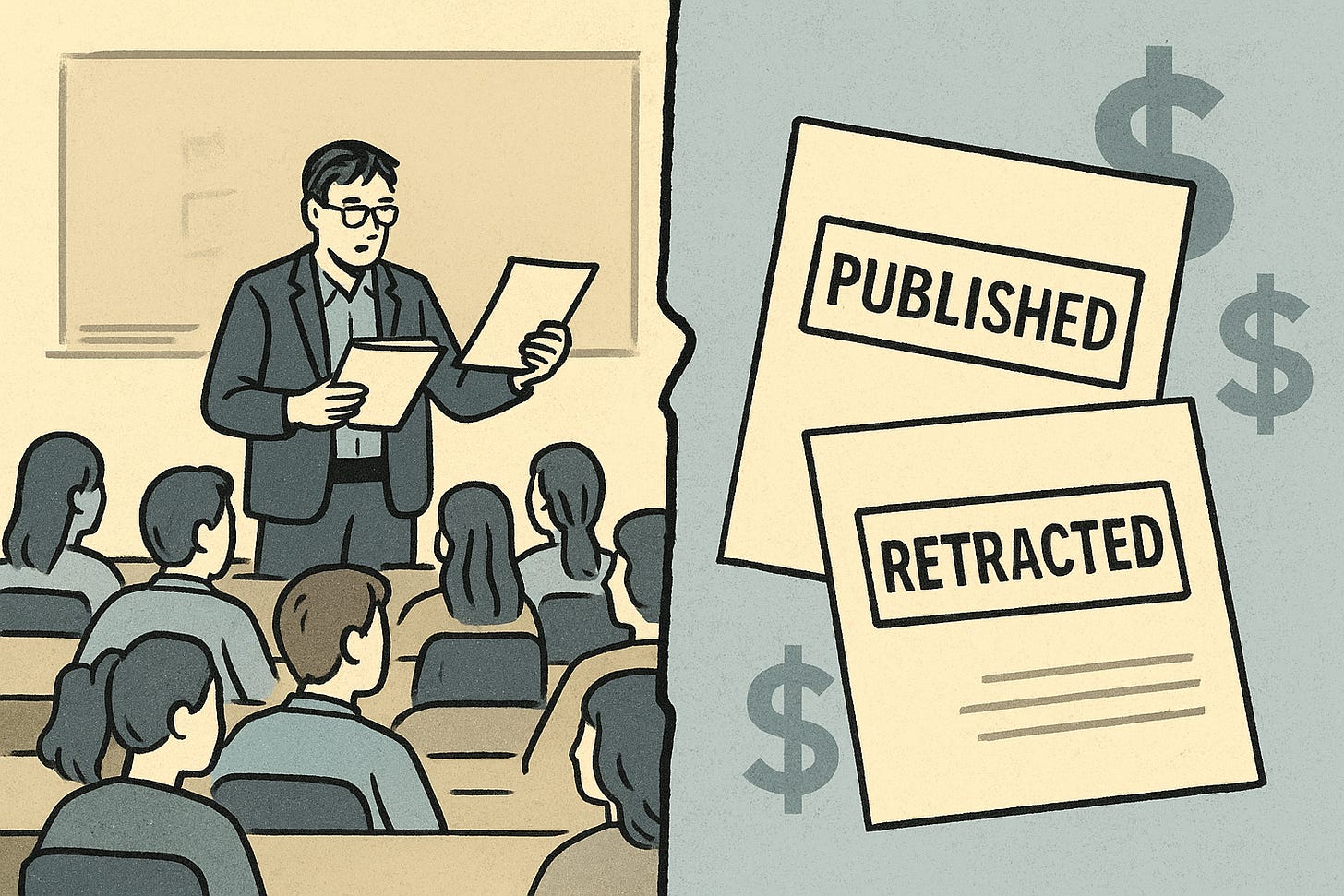
Despite the number of retracted papers exploding from roughly 1,000 a year in the early 2000s to around 10,000 annually today, Minella explains that authors rarely face meaningful consequences. There are generally no financial penalties, limited professional repercussions, and virtually no public accountability.
The system is structured to move on quickly—new papers replace old ones, and failed research quietly disappears without real acknowledgment of the cost or damage done.
Why Parents Should Be Concerned
Chuck Warren frames the issue in practical terms: if you’re a parent sending your child to a public university, why should any of this matter to you?
The answer lies in time, priorities, and incentives.
Universities increasingly measure their prestige by research output rather than teaching quality. Faculty are rewarded for publishing papers, securing grants, and increasing research metrics—not necessarily for excellence in the classroom.
As Minella explains, these incentives degrade the core mission of higher education. Professors who devote themselves to teaching and mentoring students but lack high-volume research output are often undervalued compared to those who bring in grants and publications, regardless of educational impact.
Prestige Over Education
While research can generate revenue and prestige, Minella argues that its role has become distorted. Research activity signals “elite” status, even when that research contributes little to knowledge or public benefit.
The result is a system where teaching—the very reason most students enroll—is pushed aside. Education becomes secondary to metrics, rankings, and institutional bragging rights.
For parents and students paying rising tuition costs, this should be a serious red flag.
A System Misaligned With Its Mission
At its core, the problem isn’t research itself—it’s the imbalance. When funding, prestige, and career advancement all flow toward quantity of research rather than quality of education, everyone loses.
Taxpayers fund work with little oversight. Students receive less attention. And universities drift further from their educational mission.
As Breaking Battlegrounds makes clear, it’s time to ask harder questions about whether higher education is serving students—or serving itself.
Transcript
**Chuck Warren: **So let me ask you two questions in a follow-up to this. One, who are funding these academic journals? Right? Because obviously they have an agenda that the authors of the papers are trying to fit in this tight view of their world. And second of all, you had 1,000 in the early 2000s, you have 10,000 now. You don’t hear about these papers being retracted. What happens to the authors of the papers?
When they have to be retracted, is there any punishment? Is there any financial penalty? What happens?
Timothy K. Minella: I honestly don’t think that there is much of a penalty. And I think there’s two things to point out here. The first is that the taxpayers do fund a lot of this research in various disciplines, and it’s not just the hard sciences. In many disciplines, the federal government or other levels of government is funding it in some way.
The second thing that I think a lot of people miss is that Public universities are a huge part of the higher education landscape. And these professors at public universities are expected to pump out research and expected to devote a significant amount of time to that research. So in a way, the taxpayers that support public universities are paying for professors to do this research.
Even if the taxpayer is not, the state government or whoever is not writing a check to fund this particular project that the academic is doing. They’re paying their salary and part of their job is to do this research. If this research is dubious, if it’s legitimate in terms of the methods it used, but it’s not really coming to any valuable conclusion, we should question whether that is money well spent. And that’s what one of the things this report looks at.
**Chuck Warren: **So, I’m a, let’s say, I’m a parent of a child going to the University of Arizona or Arizona State. Why should this concern me that professors who are supposed to be teaching my child and preparing them for the world after college are spending so much time on these papers? mean, how much do these papers bring in money for the university? Is this just a simple, another way to increase money like...
ASU brings in lots of international students because they pay a higher tuition? Is it just another revenue source?
Timothy K. Minella: I think there’s potential increases in revenue here. I think the bigger issue is this is part of how universities show their prestige. And I don’t think it should be like this, but this is the fact that if you have higher research activity, you are seen as a more elite institution. And I think the incentives here are very out of whack because one thing this does is it really degrades as you point to teaching.
It makes it so the education part of higher education is simply less valued. That the professors, and they may be few and far between, but those providing really good education to their students, if they don’t also have the research activity, the big publications, the grants, cetera, with that, they are not as valued as the ones that are bringing in lot of grants and research.
Listen to the full episode of Breaking Battlegrounds anywhere you stream your podcasts!