For four years, the southern border dominated headlines. Daily crossings in the hundreds of thousands. Overwhelmed agents. Entire communities pushed past their breaking point.
Now?
Silence.
That silence, according to award-winning journalist Anna Giaritelli, may be the biggest border story of the year.
On Breaking Battlegrounds, guest host Chuck Warren sat down with Giaritelli—one of the nation’s leading reporters on immigration and border security—to explain why the lack of coverage isn’t accidental, what has fundamentally changed on the ground, and why enforcement has shifted from the border itself to the interior of the country.
When the Crisis Disappears, So Does the Coverage
Anna Giaritelli didn’t hesitate when asked what the biggest border story of the year is.
It’s not chaos.
It’s not collapse.
It’s the absence of both.
Under the Biden administration, Border Patrol arrests regularly ranged from 100,000 to 250,000 per month, and that figure didn’t include the countless migrants who evaded apprehension altogether.
Today, that number has dropped to 5,000 to 10,000 arrests per month.
The difference isn’t subtle. It’s dramatic.
But because the situation has stabilized, the media spotlight has moved on.
As Giaritelli explained, when the border was in crisis, it dominated coverage. Now that it’s relatively quiet, there’s “nothing to cover”—and good news doesn’t generate clicks.
A Border So Quiet It’s Like a Park
Chuck Warren noted the irony: when the border was effectively open, it was nonstop news. Now that it’s largely closed, the story has faded into the background.
Giaritelli agreed—and said that while she’s heading back to the border soon, the nature of reporting has fundamentally changed. Instead of chaos, the focus is on reinforcement.
One of the most significant developments coming next: hundreds of miles of floating barriers across the Texas–Mexico border.
The Buoy Barrier: A Marine Wall
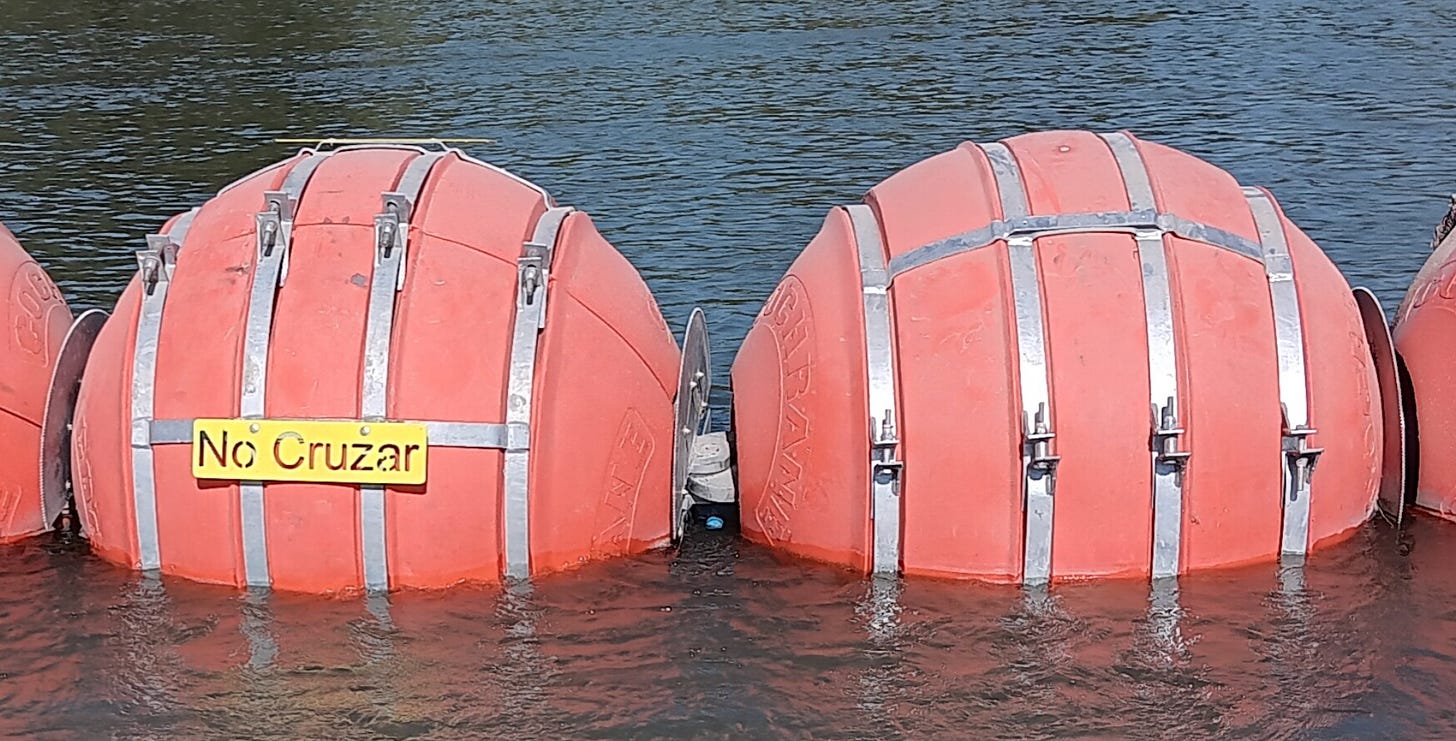
The Trump administration is moving forward with plans to install approximately 500 miles of buoys along the Texas border—essentially a “marine wall” in the Rio Grande.
These aren’t small floating markers.
As Giaritelli explained, the buoys previously deployed by Governor Greg Abbott near Eagle Pass were six to eight feet in diameter, reinforced with underwater netting, and designed to be impossible to swim under, climb over, or bypass easily.
Texas alone has roughly 1,250 miles of river border, and while not all sections are deep enough to require barriers, many are prime crossing points.
The goal is simple: make illegal crossings as difficult and dangerous as possible—so they don’t happen at all.
From the Border to the Interior
Perhaps the most important shift isn’t happening at the border anymore.
It’s happening inside the country.
Giaritelli noted that early in the Trump administration, enforcement priorities moved from simply stopping crossings to interior deportation operations—locating, detaining, and removing individuals already inside the U.S. illegally.
That shift explains why the border is quiet—and why the real operational focus has moved inland.
In other words:
The border problem didn’t disappear.
It was addressed.
The Bottom Line
The biggest border story of the year isn’t chaos—it’s control.
Arrests are down.
Crossings have collapsed.
Infrastructure is being reinforced.
And because of that success, the issue no longer dominates the news cycle.
As Anna Giaritelli made clear, the quiet isn’t accidental—and it isn’t permanent unless enforcement continues.
Sometimes, the most important stories are the ones you don’t hear about anymore.
Transcript
Chuck Warren: Welcome. I’m your host Chuck Warren with Breaking Battleground. Sam Stone has the flu and he’s out today. It’s our first show of the 2026 year and we are honored to have a friend of the show and one of the best reporters in the nation, Anna Giaritelli. She is an award winning journalist.
She writes for the Washington Examiner on US border crisis. And she’s also earned the runner up for the 2024 Dow Prize for investigative reporting. She’s on many shows and she’s always so kind to come visit with us. And we’re gonna talk about her book that’s coming out in April. And we’re also gonna talk about various things on the border. Anna, welcome to the show.
Anna Giaritelli: Thanks so much for having me.
Chuck Warren: All right, so you did a video talking about the biggest story of the year. Not to hold our audience in suspense, what is the biggest story of the year?
Anna Giaritelli: I think it’s ironically when we don’t hear much about the border. The border is in a completely different place than it was a year ago or under the Biden administration. For four years, we saw it at historic highs with 100,000 to 250,000 people coming across every month and getting arrested. And that doesn’t include the people who got away and weren’t apprehended.
And now we’re seeing 5,000 to 10,000 arrests per month under the Trump administration. So it’s as black and white as it could be. And because it’s so quiet, it doesn’t get a lot of attention. And so I think that’s why the public isn’t hearing so much about it.
Chuck Warren: Well, yeah, I was reading a study last month and the author just said, as a psychologist said, we only remember the bad things, we don’t remember the good things. It’s the first thing we stick on. So now you have this news that a border that was completely open under the Biden administration, Trump has come in and closed it. So now, of course, it doesn’t get any news because I mean, for example, you covered it. What do you? It’s probably limited. There’s nothing to cover. it’s like going to a park.
Anna Giaritelli: Yeah I am headed down to the border next week, we’re going to have, we’re going to bring a pretty big story. Well, I’ve already reported it, but they’re going to, they’re going to start putting in buoys across the Texas Mexico border, 500 miles of buoys in the river, sort of as a Marine wall, right?
Chuck Warren: Okay.
Anna Giaritelli: And so that is, that’s going to be a huge, huge deal that the Trump administration is going to be on the ground doing. But yeah, just to shore up security that much more because they can. But you’re right, the focus, and I said this early on in the Trump administration, the focus has gone from the border to the interior of the country where the deportation operation is occurring.
Chuck Warren: Let me go back to the buoys for a minute. What percentage of the illegal immigration came across our border via those rivers? I mean, I there’s dry spots that come through. What percentage do you think went through the rivers that it’s required we go put 500 miles of buoys up?
Anna Giaritelli: It’s hard to say because the border, there’s a saying among the border patrol, if you’ve seen a mile of the border, you’ve seen a mile of the border, which just means every mile varies. It’s different across Texas, roughly the entire 1,250 mile of Texas border is a river. Some parts are too shallow to be a river that someone would have to swim across. And then other parts of the California, New Mexico and Arizona borders also have sometimes water, canals. But not so much typically land.
So they’re gonna put in as much doing as they can across the Texas border with Mexico. And they’re they’re gonna continue adjusting they might be doing more than five hundred. But those buoys are very difficult to get across. They’re not like you know two foot buoys in the river. The ones put an eagle pass by governor Greg Abbott a couple years ago were about six eight feet diameter see you can’t get under and there’s netting below them as well and then you can’t get over them.
Listen to the full episode of Breaking Battlegrounds anywhere you stream your podcasts!