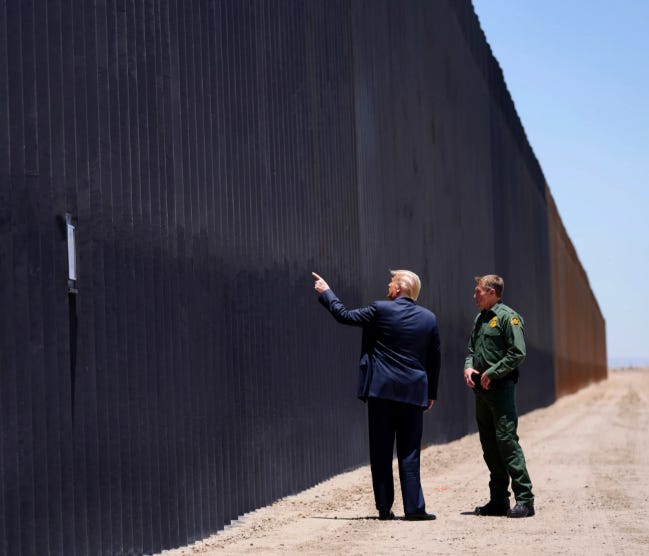
For years, debates around the U.S.–Mexico border have focused on a single image: a towering steel barrier stretching across rugged terrain. But in 2025, that picture is shifting. Border security is no longer just about steel and concrete — it’s about sensors, machine learning, lighting systems, and AI-enabled tools designed to expand the eyes and ears of every Border Patrol agent on the ground.
On the latest episode of Breaking Battlegrounds, Washington Examiner reporter Anna Giaritelli returned to the show to break down her newest reporting on what she calls “Trump’s Smart Wall.” After more than 60 trips to the border and years of firsthand coverage, Giaritelli offers a detailed look at how the next version of the Trump-era project is taking shape — and what it means for the future of immigration enforcement.
Below is a breakdown of the conversation.
Trump 2.0: The Wall That Thinks
Host Chuck Warren begins by asking Giaritelli about her latest piece: a deep dive into the upgraded wall system being pursued in Trump’s second term.
Giaritelli explains that this isn’t simply a reboot of the original border wall project — it’s an evolution.
What’s new?
-
Advanced AI and machine learning tools
-
Extensive surveillance technology
-
Improved lighting and road infrastructure
-
18- to 30-foot steel barriers where physical walls are added
During Trump’s first administration, more than 700 miles were funded and roughly 450 miles were completed. But while the physical structure went up, the technological components never reached full deployment before President Biden canceled the remaining contracts.
Now, with four years of rapid innovation behind us, the redesign looks dramatically different.
“Technology has changed,” Giaritelli notes. “AI is in the daily lives of regular Americans now. So what they’re rolling out on the border is much more advanced than anything proposed eight years ago.”
A Border That’s Wired from End to End
The biggest revelation: even if every mile of steel isn’t completed, the entire 2,000-mile southern border is slated to be equipped with technology — cameras, sensors, and automated systems capable of real-time monitoring.
This is a shift away from relying solely on physical wall mileage.
Trump originally promised to finish the wall, and while there remain roughly 300 miles previously funded but not built, the greater emphasis now is on maximizing the reach of technology.
According to Giaritelli:
-
$5 billion is already allocated for this reboot.
-
The goal is full technological coverage, even without full physical coverage.
-
Machine learning tools will allow agents to detect, predict, and respond to crossings more effectively.
In other words: the wall won’t just stand there — it will process information.
The Border Debate Moves Into a New Phase
The conversation highlights an important shift: the argument over whether a wall “works” may soon become outdated. The U.S. is no longer just building a wall — it’s building a smart system that blends physical barriers with digital intelligence.
Giaritelli stresses that this hybrid approach is designed to assist agents, not replace them, creating a force multiplier across a challenging and massive landscape.
As the 2025 border debate heats up, this smart-wall strategy will likely become a central part of the national conversation.
Transcript
Chuck Warren: Welcome back to Breaking Battlegrounds. For our final segment on the show today, we have a friend of the show, a great reporter with The Washington Examiner, Anna Giaritelli, and she covers the border for The Washington Examiner. She’s been there over 60 times. And she also has a book coming out next year. First, Anna, welcome back to the show.
Anna Giaritelli: Thanks so much for having me.
Chuck Warren: So you have a piece out today that Trump is building a smart wall on the border. What does that mean?
**Anna Giaritelli: **Yeah, the wall has, it’s Trump 2.0, it’s taken a step up. This one is smart, right? Right. You know, during the first Trump administration, we saw over 700 miles of wall funded, about 450 completed. A lot of what was built was the wall, right? But the technology side of things wasn’t completed by the time Trump left office.
And then president Biden canceled the remainder of the contracts and what was supposed to be finished. So even in the four years between Trump’s first term and second term, technology has changed. You and I both know that AI is now in regular Americans lives. And so now they are adding in not just the roads that are necessary, the lighting, but technology that would blow your mind a lot of machine learning.
So stuff that even four to eight years ago would be fading out now, not as relevant. And so that is what makes this whole process, in addition to adding a lot more physical barrier, 18 to 30 foot steel wall, adding in a lot of the smart technology. So it makes it go beyond just a barrier, but something that really works for agents and helps them do their job.
Chuck Warren: Repeat for audience again how many more miles wall do they plan to build in his first term?
Anna Giaritelli: They, I mean, Trump promised to finish the wall. He wanted to, they have about 300 more that was funded and not completed. This time they’ve been able to put 5 billion towards this new project going on. They’re not going to finish the wall, but they will have technology across the entire 2000 miles southern border, which is a lot more than we have right now.
Listen to the full episode of Breaking Battlegrounds anywhere you stream your podcasts!