Every Thanksgiving, we celebrate unity. We celebrate the idea of people sitting together, breaking bread, and working through impossible hardships side by side. But in this year’s Breaking Battlegrounds Thanksgiving Special, historian and bestselling author Bill Federer reminds us that the early American colonies were anything but unified.
In fact, the founding religious communities of America often persecuted each other long before they ever dreamed of forming a single nation. Quakers were kicked out of Massachusetts. Puritans were driven out of Virginia. Lutherans were pushed out of New York. Every colony had its own doctrine—and they defended it fiercely.
What changed wasn’t their theology.
It was their fight for survival.
Persecution Was the Norm—Until a Common Enemy United Them
Chuck Warren asks a key question: Did the colonies really practice the tolerance they preached?
Federer answers bluntly: “Most of the time they did not.”
-
Massachusetts (Puritan) → expelled Quakers
-
Virginia (Anglican) → drove out Puritans
-
New York (Dutch Reformed) → chased out Lutherans
The colonies were fractured, suspicious of each other’s beliefs, and unwilling to coexist. That is, until the Revolution forced them into the same foxhole.
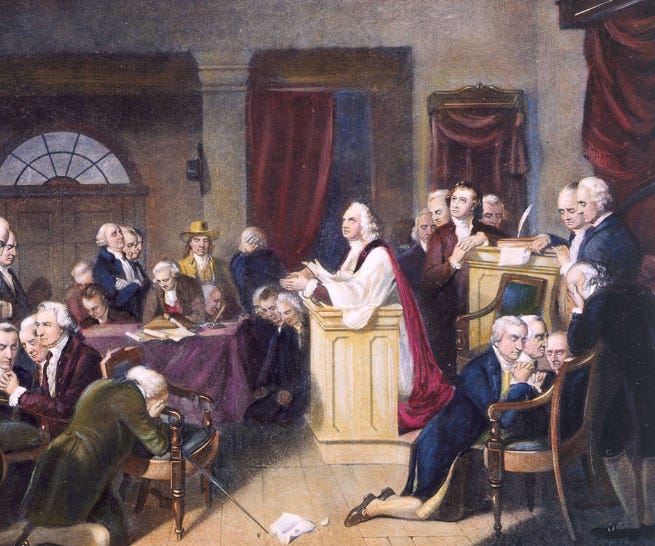
At the First Continental Congress, even opening with a prayer sparked heated controversy. Delegates didn’t want to listen to a prayer from another denomination. But in a pivotal moment, Sam Adams stood and declared:
“I’m no bigot. I can hear a prayer of any man of piety who at the same time is a patriot of the nation.”
That was the beginning of a shift—a realization that freedom required unity, not uniformity.
After the Revolution: A Radical New Idea Takes Hold
Federer explains that after fighting and dying beside each other, the colonies’ outlook changed. They had shared pain, shared blood, and a shared enemy. With that came a new belief:
“We may not always agree on religion, but you were willing to fight for my freedom. I need to let you practice your faith.”
This mindset—tolerance through mutual sacrifice—became foundational to American identity.
Yet, as Federer points out ironically, the faith tradition that founded the country is now often the only one not culturally tolerated. America’s tolerance expanded outward—from Protestants to Catholics, then Jews, then secularists, then Muslims and beyond—but modern politics often turns that inclusivity back on its head.
The King’s Charters and the Patchwork of Faith
Sam Stone raises another question: If the King granted each colony’s charter, how did we end up with such a diverse religious landscape?
Federer breaks it down:
-
Virginia → Anglican
-
Massachusetts → Puritan (originally meant for the Pilgrims)
-
Rhode Island → Baptist (thanks to turmoil in England)
-
New York → Dutch Reformed
-
Delaware & New Jersey → Swedish Lutheran, then Dutch, then English
-
Connecticut & New Hampshire → Congregationalist
-
Pennsylvania → Quaker “experiment” in religious coexistence
Pennsylvania, he explains, was truly revolutionary. It was the first real-world test of whether people with totally different religious convictions could live together in the same community.
A melting pot before America even existed.
Philadelphia: The First Place Americans Truly Came Together
John Adams described visiting Philadelphia as his first exposure to real religious diversity. In his journals, he writes about experiencing Quaker meetings, Catholic Mass, and other traditions for the first time—an experience that would have been impossible in his home colony.
This is why the Continental Congress could meet there.
This is why America could be born there.
Philadelphia was the place where American tolerance became real, not theoretical.
Final Reflection
This Thanksgiving episode reveals a forgotten truth: America didn’t begin as a united people. It began as a collection of competing, conflicting, often hostile communities. Tolerance wasn’t handed down—it was fought for, learned through hardship, and solidified through shared sacrifice.
And that’s the real Thanksgiving story:
A reminder that unity is always possible, even among people who deeply disagree—if they’re willing to stand together for freedom.
Transcript
Chuck Warren: So these colony, the states and the colonies, did they suppress, so if you’re a Swedish Lutheran and there’s a Catholic in that state, did they persecute that Catholic in the state? Did they, I mean, did they walk the walk?
**Bill Federer: **Most of the time they did. So in Massachusetts, they drove out Quakers. In Virginia, they drove out Puritans. And Quakers were sort of driven out everywhere. In New York, was Dutch reformed, and they chased out Lutherans. And they didn’t get along until the revolution started. And then they had to work together against the King of England. Matter of fact, the first Continental Congress, a motion was made to open with prayer.
John Adams writes about it and he says that Mr. Rutledge of South Carolina objected to a prayer because he didn’t want to hear a prayer from a different denomination. We were so divided in our religious sentiments. And then Sam Adams stands up and he goes, I’m no bigot. I can hear a prayer of any man of piety who at the same time is a patriot of the nation. So they all worked together against the king.
After the revolution, their attitude changed to we may not always agree on religion, but you are willing to fight and die for my freedom. I need to let you practice your faith. So they’re being able to tolerate each other. First Protestants, and then Catholics, then Jews, and then finally went out to the atheists and the secularists and the Islamists and the Satanists and the last ones in. Want to kick the first ones out? So everybody’s tolerated in America, except the Christians that founded the country.
Sam Stone: So if all these colonies were founded with this great diversity of religion How did that happen given that each of them had to be founded with a charter from the king?
Bill Federer: Right, so each colony, so Virginia was an Anglican colony. Massachusetts was a Puritan colony. Originally the Pilgrims were gonna go to Virginia, they get blown off, course, to Massachusetts. Then you have Rhode Island. Rhode Island was founded when King Charles I had his head chopped off, and so you had the Puritans running England, and so they get the Rhode Island and Connecticut charters. New York was Dutch reformed.
1624. And then Delaware and New Jersey were originally Swedish Lutheran and then taken over by the Dutch and then taken over by the English. Connecticut and New Hampshire were congregationalists and then Pennsylvania was the great experiment. Philadelphia means city of brotherly love and so William Penn let any Christian group come into Pennsylvania to see if they could live together in the same geographic area.
So Pennsylvania was this experiment of you could actually have Catholics and Protestants and Lutherans and everybody in the same geographic area. What a novel idea.
Chuck Warren: Right.
Sam Stone: I had no idea that that was sort of the first religious melting pot of this continent.
**Bill Federer: **Yeah, and so that’s why they all felt comfortable going to the Continental Congress, where in Philadelphia, John Adams writes that’s the first time he visited other churches because his country, which is what he called his state of Massachusetts, it was congregational Puritan. He visits a Quaker meeting house. He visits a Catholic church. He visits, you know, these other different denominations. And it’s quite interesting to see his record of it. But they all felt comfortable coming to Philadelphia.
Listen to the full episode of Breaking Battlegrounds anywhere you stream your podcasts!