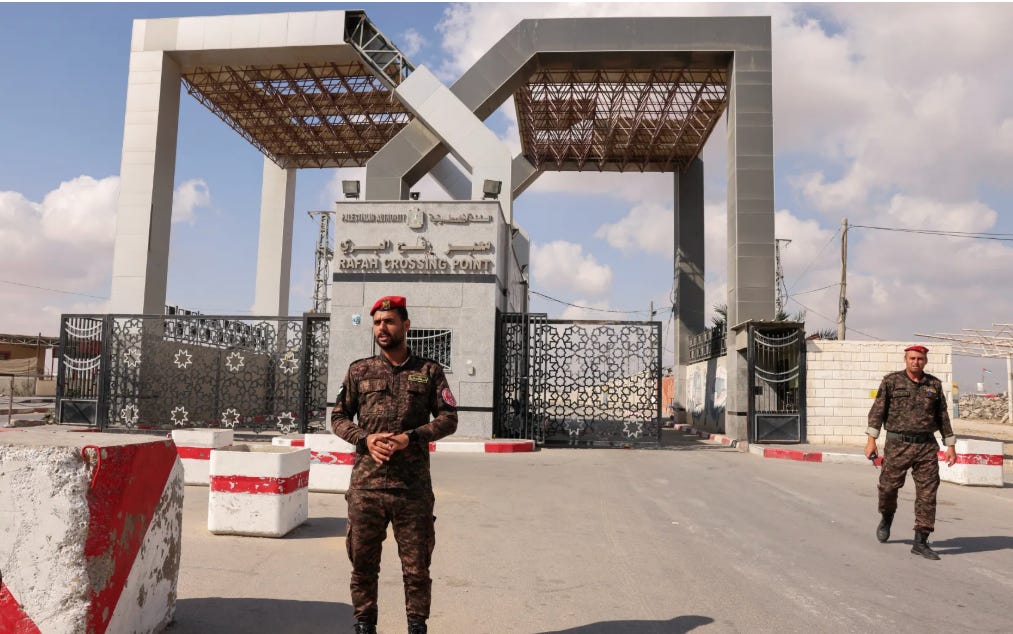
Everyone talks about Gaza and Israel. Almost no one talks about the third player in the drama: Egypt. While headlines focus on rockets, ceasefires, and peace talks, Cairo has quietly been making decisions at the Rafah border that could shape the entire future of the conflict.
In a recent conversation with Chuck Warren and Sam Stone, Middle East analyst Mariam Wahba broke down why Egypt’s role is so critical—and why it’s far more complicated than outsiders assume.
Before October 7th: A Quiet but Fragile Border
Before Hamas’ October 7th attack, the Rafah Crossing—the only Gaza exit not under Israeli control—was relatively subdued. But the Sinai Peninsula surrounding it was anything but calm.
For years, Sinai had been a hotbed for jihadist activity, forcing Cairo to pour in troops, resources, and intelligence to maintain control. Wahba reminded listeners that Israel even provided air support to Egypt during counterterrorism operations there, an unusual but telling sign of shared security concerns.
After October 7th: Fortification and Fear
Once the October 7th assault shocked the region, Egypt slammed shut and fortified its border with Gaza. The calculation was clear: if militants could slip into Sinai, the threat would metastasize beyond Gaza’s confines.
At the same time, international voices began pressing Egypt to open its gates to Palestinian civilians. On paper, it seemed like a humanitarian solution. In reality, Mariam Wahba explained, it carried staggering risks.
Why Egypt Won’t Take in Refugees
According to Wahba, there was a narrow window at the start of the war when U.S. pressure might have persuaded Egypt to absorb displaced Palestinians, at least temporarily. But now—nearly two years later—the idea is untenable:
-
Scale: Asking Egypt to take in two million Gazans would overwhelm its already strained political and economic capacity.
-
Security: Even a handful of Hamas operatives blending into refugee flows could turn Sinai into a launchpad for attacks against Israel.
-
Diplomacy: Such a development would almost certainly destabilize the Camp David Accords, the cornerstone of Egyptian-Israeli peace for nearly five decades.
The Unspoken Risk
Mariam Wahba paints a chilling “what if”: rockets fired into Israel, not from Gaza, but from Egyptian soil. That nightmare scenario would instantly drag Cairo into direct confrontation with Jerusalem—undoing decades of painstaking peace and igniting a wider regional crisis.
Closing Takeaway
The temptation is to frame Gaza’s tragedy as a two-sided conflict. But Wahba’s analysis reminds us there’s a third border in play—one with stakes just as high as those in Israel or Gaza itself.
Egypt isn’t just a bystander. Its choices at Rafah could decide whether the Middle East edges toward containment or chaos.
Transcript
**Chuck Warren: **Yes, exactly. Mariam, one thing that is not discussed enough with the current conflict in Gaza is the border with Egypt. What was the border with Gaza like for Egypt before October 7th and what's it like now after October 7th? And what are your thoughts on this and should Egypt allow more Palestinians to come into from Gaza into Egypt?
**Mariam Wahba: **What a wonderful question so the Sinai peninsula is the part of Egypt that go lead into that Rafah crossing border that connect Egypt and Gaza and Egypt and Israel. Before October 7th is it was pretty quiet. Obviously Rafah crossing is for the main crossing out of god that is not Israeli controlled or was not Israeli controlled before the October 7th attack.
And I want to point our attention here to the Sinai as a whole region before we kind of discussed the crossing itself. Sinai is a particularly terminalist or filled with turmoil region because it was a hot bed for Isis actually up until very recently. So Egypt saw Sinai as a huge threat and placed huge amounts of resources military economic resources in Sinai to make sure that it cannot be a hotbed for Islamist and particularly Isis.
A fun fact that little people know is the Israelis actually provided the Egyptians air support when the Egyptian government was striking Isis targets in the Sinai. So that kind of began to paint a picture of how Egypt looks at this part of of its country that goes into the border with with Gaza. In the aftermath of the October 7th Egypt obviously fortified it's fault with Gaza to make sure that they don't have terrorism spilling into its territory.
And there was this massive call, as you referred to, for Egypt to take in Gazan refugees. And my argument here is, in the early days of the war, that would have been possible with the right pressure from the White House. If the Biden White House at the time had pressured Egypt to open its borders in anticipation of the Israeli offensive in Gaza, that would have made a lot of sense. It wouldn't have been accepted by Egypt, I predict, but it would have made more sense.
Now that we're two years into the war, asking Egypt to absorb 2.1 million Palestinians into its territory is quite a tricky thing. They don't have the political capital to do that. And furthermore, obviously Egypt and Israel have this enduring peace between them, Camp David Accords. And, you know, hypothetically, stay with me here. If Egypt were to take the two, let's call it two million even Palestinian civilians into Sinai,
at some point a Hamasnik, a Hamas operative, might spill into those two million civilians. And then we're going to have Hamas operating on Egyptian soil, eventually, you know, launching missiles in this hypothetical from Egyptian soil to Israeli territory. And talk about catastrophe. That would be catastrophic for the Israeli-Egyptian peace.
Listen to the full episode of Breaking Battlegrounds anywhere you stream your podcasts!