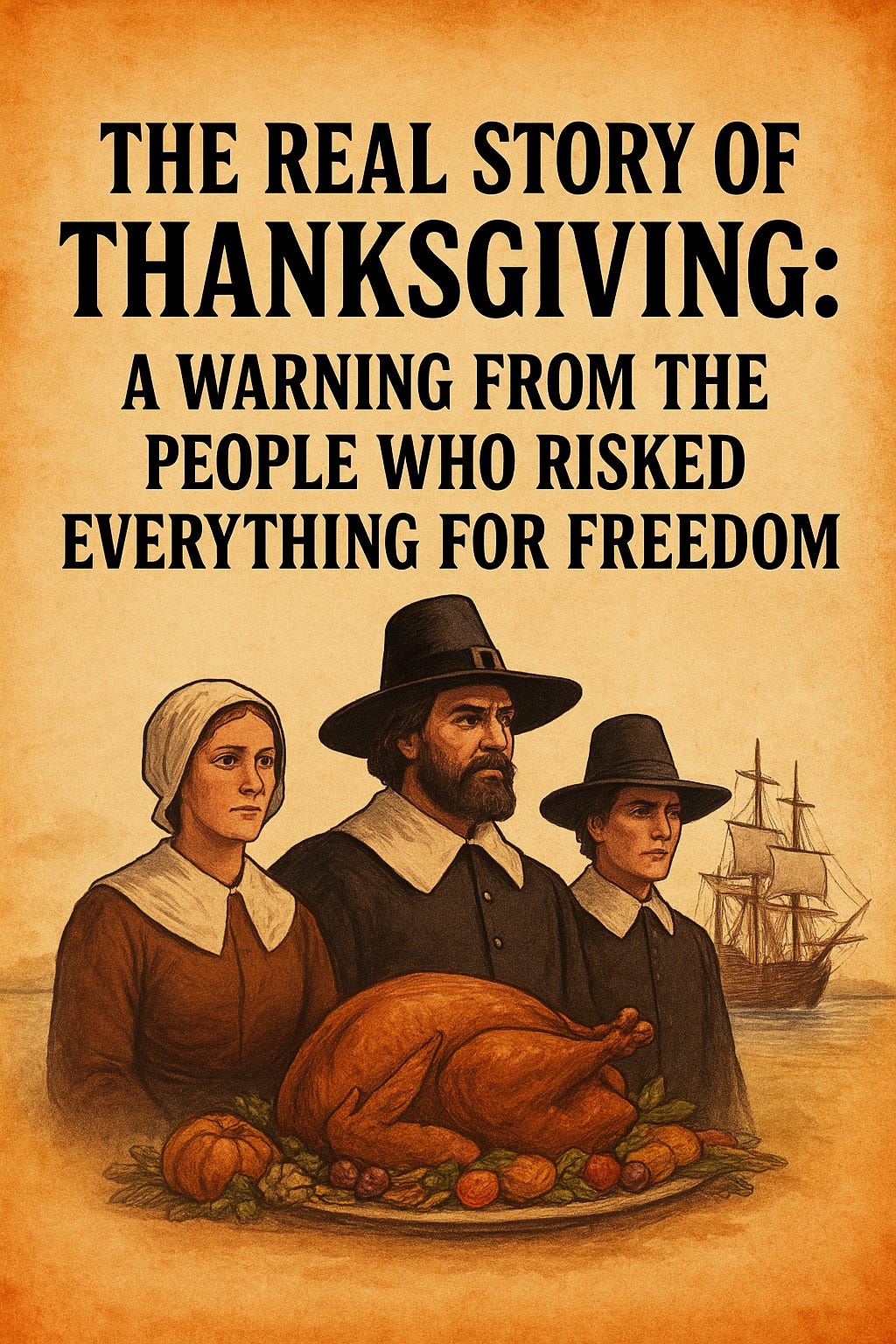
Most Americans sit down to Thanksgiving without realizing they’re reenacting a moment born out of resistance, rebellion, and a desperate flight from government-controlled speech. We associate the holiday with comfort, family, and turkey—yet the people who made it possible lived in a world where the government told you what to believe, what to say, and even what words you were allowed to pray.
This recent special Thanksgiving episode of Breaking Battlegrounds cuts through the folklore. Sam Stone and Chuck Warren sit down with historian, bestselling author, and host of Faith in History, Bill Federer, to expose the forgotten—and shockingly relevant—story behind Thanksgiving’s origins.
And if you think this history belongs only to the 1600s, you might want to hear what Federer has to say about England’s current free-speech laws, modern political persecution, and why the past may be repeating itself more quickly than anyone expected.
What Americans Get Wrong About Thanksgiving
Chuck Warren opens with a simple question: What do Americans misunderstand about Thanksgiving?
Bill Federer doesn’t hesitate.
“They came over for religious freedom… In England, they were canceling people for saying something different than what the government wanted them to say.”
Sound familiar?
The parallels are eerie. Before the Pilgrims ever stepped on the Mayflower, England was deep into its own version of speech policing—where dissent wasn’t just frowned upon, it could get your ear cut off, your face branded as a heretic, or land you in the infamous Star Chamber.
The Pilgrims Weren’t Just Seeking Freedom—They Were Fleeing Totalitarianism
Federer walks listeners through the brutal landscape the Pilgrims escaped:
-
King Henry VIII declared himself head of the church and outlawed any belief he didn’t approve of.
-
All prayers were pre-written by the government. Deviate—and you could be imprisoned.
-
Small private meetings? Raided.
-
Critics? Branded, tortured, or dumped into prisons like Newgate.
One Baptist leader died behind bars for simply saying no man should be persecuted for his religion—a statement now foundational to American liberty.
Federer points out the chilling lesson: The people who founded America weren’t chasing comfort. They were running from authoritarian control.
The Original Free-Speech Dissidents
Sam Stone notes how modern the story feels:
“The parallels today to what drove that movement are astounding.”
And they are.
Federer highlights how each American colony was founded by a different religious group—Anglicans in Virginia, Puritans in Massachusetts, Baptists in Rhode Island, Quakers in Pennsylvania—and each of them had fled a Europe where the government enforced ideological uniformity.
They weren’t just Pilgrims.
They were the first generation of free-speech dissidents—people who risked imprisonment, torture, and exile for the right to think freely.
Modern Parallels: When History Starts Repeating Itself
The episode takes an unexpected turn: Federer points out that in modern England, free speech is again under assault.
-
16,000 people imprisoned for online speech.
-
Some jailed for liking a tweet.
-
Over 30 arrests per day for “petty online offenses.”
He describes a pastor in South Korea imprisoned for organizing protests against government-supported movements—yet another echo of the Star Chamber logic the Pilgrims fled.
Chuck Warren sums up the reaction for many listeners:
“I did not realize that.”
Thanksgiving Is More Than a Holiday—It’s a Warning
The heart of this episode is a reminder: Thanksgiving isn’t just a celebration of survival. It’s a celebration of resistance.
The Pilgrims didn’t risk their lives for food, land, or prosperity. They risked everything for the right to speak, pray, believe, and live without government control.
As Federer frames it, the story of Thanksgiving isn’t a cozy myth—it’s a cautionary tale that feels more relevant than ever.
Final Thoughts
This Thanksgiving, as families gather around the table, most won’t think about the price that was paid to ensure they could speak freely, worship freely, and disagree freely.
But this episode reminds us:
The freedoms we enjoy exist because a small group of people refused to live under censorship—and they paid for that decision in blood, exile, and suffering.
Their story is our inheritance.
Their warnings are our responsibility.
And their courage is worth remembering—now more than ever.
Transcript
Sam Stone: Welcome to another episode of Breaking Battlegrounds, a very special Thanksgiving episode for everybody today, and we hope you are going to be having a wonderful Thanksgiving, or have already had a wonderful Thanksgiving with your family. Our first guest today, Bill Federer, nationally known speaker, bestselling author, and president of AmeriSearch, a publishing company dedicated to researching and preserving America’s noble heritage, but you likely know him from his daily American Minute radio feature heard across the country or from his television program, Faith in History, which airs nationwide on TCT Network and on DirecTV. Bill Federer, welcome to the program.
Bill Federer: Hey, it’s great to be with you.
**Chuck Warren: **Bill, what do Americans not understand about the history of Thanksgiving? What is their misperception of it?
**Bill Federer: **Yeah, well, one of the first things is they came over for religious freedom. So in England, they were canceling people for saying something different than what the government wanted them to say.
**Chuck Warren: **So basically like today, like their social media clamped down today.
Sam Stone: As I was listening, watched several of his things on YouTube last night. And I will tell you, the parallels today to what drove that movement are astounding.
**Chuck Warren: **Go ahead.
Bill Federer: Yeah, it’s similar. Henry VIII broke from the Catholic Church, but then he made himself the head of the Anglican Church and he canceled anybody that disagreed with him. Catholics, Puritans, Presbyterians, and the Baptists, whom we call Separatists or Pilgrims. And so the attitude was, yes, you can read the Bible in your own language, but you still can’t believe whatever you want. You have to believe what the government tells you to believe.
And so they wrote all the possible prayers down and put them in a book called the Book of Common Prayer. So you don’t even make up your own prayers because you couldn’t make up one that’s wrong. And so if you’re having a small group meeting, the government will kick in the door and drag you away to the star chamber. It was like a hidden government hearing room and they had stars on the ceiling, but they’d twist your arm off an ear or cut a nose in half or brand you on the face as a heretic.
And so that’s what the setting was. You had the one Baptist founder, John Merton, he dies in the Newgate prison. He had written, no man ought to be persecuted for his religion. And that obviously is a setting for Roger Williams, the Baptist that founded Rhode Island. And he said, enforced uniformity is the greatest occasion of civil war, ravishing a conscience, persecution of Christ Jesus in his servants.
Even William Penn was put in the Tower of London for eight months and he wrote, Force makes hypocrites. It’s his persuasion only that makes converts. You know I was speaking with an Anglican priest named Calvin Robinson and he’s been on YouTube and debated at Oxford, but he’s moved to Grand Rapids, Michigan. And he says, I can’t go back to England. I’m like, what? He goes, censorship laws. 16,000 people are in prison in England today. Some for as little as liking a tweet or forwarding a post.
Forbes Magazine has an article of people are being thrown in UK prisons over what they’ve said online. Another New York Post article, UK free speech crackdowns. He’s up to 30 people a day arrested for petty offenses such as retweets. And so matter of fact, I was in South Korea with Charlie Kirk, just four days before he was shot. And we met with a pastor, Son, S-O-N, and he’s in prison right now.
Because he organized a million Koreans against the trans agenda over there. So this is sort of the norm of totalitarian governments is they want to limit the speech of people that they disagree with. That’s one thing. It’s just sort of a highlight that the pilgrims went through these struggles.
Sam Stone: They were the-
Chuck Warren: I did not realize that.
**Sam Stone: **I knew parts of that and it’s amazing how much they were the original free speech, free speech objectors, the people who put their lives on the line to escape that totalitarianism.
Bill Federer: Yeah, you know the and then I read through the charter of every column every colony was started by a different denomination Virginia was Anglican Massachusetts was Puritan Rhode Island was Baptist New York was Dutch reform Delaware New Jersey were originally Swedish Lutheran and of course Pennsylvania Quaker. But they fled from Europe because in Europe it was one denomination per kingdom And if you didn’t believe the way your king did you’re persecuted and you fled.
Listen to the full episode of Breaking Battlegrounds anywhere you stream your podcasts!