When we talk about America’s religious freedom, we often imagine it as something that appeared fully formed in 1776—neat, orderly, and intentional. But the truth is far more chaotic and far more interesting.
On the latest episode of Breaking Battlegrounds, author and historian Bill Federer walks us through how a chain reaction of disagreements, divorces, royal egos, rebellious congregations, and even technological breakthroughs ended up shaping not only American religion—but American government itself.
What emerges is a story of competing convictions, new ideas spreading like wildfire, and ordinary believers inventing new ways to live together. It’s the story that makes America… America.
The Reformation That Started It All
Federer begins with the spark: Martin Luther, 1517.
What started as a protest over fundraising practices for the Vatican—indulgences—launched a global movement that fractured Christianity and set Europe on a collision course of competing doctrines and political upheaval.
But then came a twist:
Henry VIII, whose break from Rome had nothing to do with theology at all. His desire for a male heir—and the Pope’s refusal to grant a divorce—pushed England into a brand-new religious identity. And with Henry as his own pope, a wave of new tensions emerged.
Diverging Paths: How Denominations Formed
Federer explains that the centuries ahead brought a parade of new denominations, each one formed in response to persecution, conviction, or political pressure:
-
Scotland created the Presbyterian Church, governed by elected elders rather than bishops.
-
Puritans tried to reform the Anglican Church from within—until the king cracked down.
-
Pilgrim Separatists (later Baptists) gave up on reform altogether and met secretly, often raided by authorities.
-
Quakers eliminated traditional clergy entirely—radically welcoming women, Black believers, and people of all backgrounds into leadership and participation.
Each group crafted a different answer to the same question:
How much authority should clergy have—and how much belongs to the people?
The Printing Press Changed Everything
According to Federer, the theological battles weren’t the only revolution underway.
The invention of the printing press meant ordinary believers could read Scripture themselves for the first time.
This single innovation shifted power away from clergy and sparked a surge in congregational involvement, literacy, and personal interpretation.
Suddenly, faith became something the people owned—not something handed down from elites.
How Faith Became Government
The moment that truly foreshadowed America happened at sea.
When the Pilgrims were blown off course and landed in Massachusetts instead of Virginia, they found themselves outside the reach of any established government. With the captain demanding they disembark, the question became:
What now?
Their solution changed history.
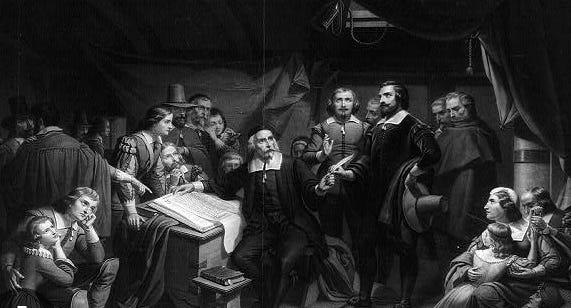
They took the covenant structure of their church—a voluntary, participatory, self-governing model—and turned it into the Mayflower Compact.
“We covenant ourselves together into a civil body politic.”
That covenant church form of government became the template for New England’s civil governments, where:
-
Churches founded towns
-
Pastors helped write civic laws
-
Congregations became communities—and communities became governments
Providence, Rhode Island, was founded by America’s first Baptist church.
Hartford, Connecticut, by its first Congregational church.
Faith communities weren’t just places of worship.
They were the architects of American civic life.
The American Innovation: Religious Diversity
In the final moments of the segment, Chuck Warren asks the obvious question:
Was America really a pioneer in religious diversity?
Federer doesn’t hesitate:
“Definitely. Definitely.”
Not because the colonies were perfect—far from it—but because the sheer variety of believers forced experimentation.
A world where one king dictated religion was replaced with a world where congregations, families, and individuals shaped their own.
America didn’t invent religious diversity, but it became the first nation to build a system that could sustain it.
Conclusion: A Country Built by Conscience
The story Federer tells is not tidy.
It’s messy, human, passionate, and often chaotic.
But that’s exactly why it matters.
America’s founding wasn’t just political.
It was spiritual, communal, and deeply democratic—built on the belief that conscience cannot be coerced and that free people can govern themselves.
It all began with people who disagreed, people who searched, and people who believed deeply enough to build new worlds.
Transcript
**Chuck Warren: **So we’re with Bill Federer. You can find him on X at Bill Federer. It’s spelled F-E-D-E-R-E-R. Bill, so you have these various Christian denominations and some of them seem very intolerant of others. What was the, I mean, I imagine they’re all believers in Christ. So what was the difference that caused them to think one side is not accurate and the other one is? I mean, what was the big divide?
**Bill Federer: **Yeah, well, the first was obviously Martin Luther. He started the Reformation in 1517, originally over the way that money was raised to build the Vatican, the indulgences being sold. Then you have Henry VIII. He broke away, not for a religious reason, he just wanted another wife. He was married to the daughter of the King of Spain. After 18 years, she didn’t have a son. He decides to divorce her and the Pope won’t recognize the divorce.
So Henry decides to break away and make himself his own pope. He unfortunately went on to have six wives and their fates were divorce beheaded died, divorce beheaded survived. Henry VIII was not a really nice guy to be married to. Scotland broke away from the Catholic Church and they set up the Presbyterian Church and presbyter means elder. So each church would elect their elders and the elders would all meet together in the city and make a covenant.
And so they pushed back against the Anglican government of the king. Puritans were inside of the Anglican church trying to purify it from within. The king didn’t think he needed any purifying, so he persecuted them. The Pilgrim Separatists or Baptists, they said, we’re just going to withdraw ourselves and meet in secret. And their little meetings would get raided. And that’s when they decided to flee to the Netherlands, eventually flee to America.
And then the Quakers were sort of Baptists with no pastor. They were a society of friends, just a bunch of guys meeting. And each one has its sort of benefits and drawbacks. But the Quakers were the first ones to let everybody participate. Women, blacks, didn’t matter what race. So it’s sort of a sliding scale. If you’re more stable, you slide to the more hierarchical clergy lady model.
And if you want more congregation involvement, you slide to the other side of the scale. A big invention was the printing press. so that, instead of the Bible being in Latin and the minister reading it in Latin and then interpreting it for you, once the printing press came about, everybody could have their own copy. And then the pastor began to coach everybody to read through the Bible themselves. And so that’s when you see more congregational participation.
That’s what the Pilgrims were. And when they get blown off course, instead of landing in Virginia, they’re on the coast of Massachusetts. There’s no government and the captain’s telling them to get off the boat and they go, what are we going to do? They said, let’s take our covenant church form of government and make it our civil government. And so that’s what the Mayflower is. It says we and the presence of God covenant ourselves together into a civil body politic. They literally took their little congregational church model and made it their civil government model.
And that became the model for New England, where you literally had pastors and churches founding cities. So Providence, Rhode Island was founded by the first Baptist church in America. Hartford, Connecticut was founded by the first congregational church in America. So everybody’s involved in church and everybody’s involved in city government because it’s the church founding the city.
**Chuck Warren: **This is, we have a minute left here in this segment. So really, America really was a pioneer in religious diversity and thought.
Bill Federer: Definitely, definitely, yeah.
Listen to the full episode of Breaking Battlegrounds anywhere you stream your podcasts!