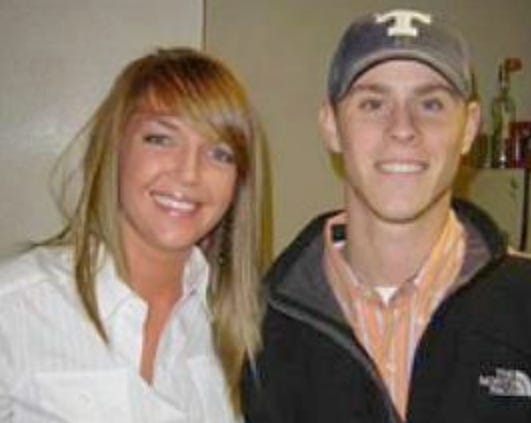
On the last B’s Crime Corner on Breaking Battlegrounds, we discussed one of the most disturbing and heartbreaking murder cases out of Knoxville, Tennessee: the murders of Channon Christian and Christopher Newsom.
This case is not easy to talk about. It is brutal, devastating, and deeply unsettling. But it is also one of those cases that people still remember years later because of the horror of what happened, the evidence that was uncovered, the misinformation that surrounded it, and the long legal battle that followed. In January 2007, Channon Christian, 21, and Christopher Newsom, 23, were a young couple in Knoxville. They were outside an apartment complex in north Knoxville when they were abducted by Lemaricus Devall Davidson and others. According to the Tennessee Supreme Court, Davidson stole Channon’s vehicle, forced both Channon and Christopher into the car, and drove them to his house. Once inside, the couple was held against their will. What followed was a nightmare.
Channon and Christopher were robbed, kidnapped, raped, and murdered. Christopher Newsom’s burned and partially nude body was found the next day beside railroad tracks not far from Davidson’s home. He had been brutally raped and shot three times. The location of his body became important because it was close to Davidson’s house. On the third day, police found Channon Christian’s vehicle abandoned down the street from Davidson’s home. Inside the vehicle, investigators discovered a bank envelope in the back seat. That envelope had a fingerprint belonging to Lemaricus Davidson, becoming one of the key pieces of evidence linking him to Channon’s car and helping lead police to his home.
The following day, investigators obtained a search warrant and entered Davidson’s house. Inside, they found something horrific: Channon Christian’s body stuffed inside a garbage can in the kitchen. Investigators determined that Channon had been beaten and repeatedly raped. A plastic bag had been tied around her head and face, causing her to suffocate to death. Her body was found inside multiple garbage bags. Davidson’s palm prints and fingerprints were found on three of the five garbage bags containing Channon’s body. Police also found personal items belonging to both Channon and Christopher inside the home.
The details only became more disturbing from there. After the murders, Davidson gave some of Channon’s clothing to his girlfriend. When Davidson was arrested, he had Christopher Newsom’s athletic shoes with him. Those details added another chilling layer to the case because the victims’ belongings appeared to be kept, used, or handed off after their deaths.
The Defendants
Five defendants were connected to the case:
-
Lemaricus Davidson
-
Letalvis Cobbins
-
George Thomas
-
Vanessa Coleman
-
Eric Boyd
Four of the five defendants — Eric Boyd, Letalvis Cobbins, Lemaricus Davidson, and George Thomas — had multiple prior felony convictions. Davidson was ultimately convicted and sentenced to death by lethal injection. Letalvis Cobbins and George Thomas were convicted and sentenced to life in prison without parole. Vanessa Coleman was convicted of facilitating the crimes and sentenced to 53 years. Eric Boyd was first convicted at the federal level and sentenced to 18 years in federal prison for being an accessory after the fact to carjacking. More than a decade later, in 2019, Boyd was convicted on state-level charges.
The Trial and Conviction
In October 2009, a Knox County jury convicted Lemaricus Davidson on multiple charges, including first-degree felony murder, first-degree premeditated murder, especially aggravated robbery, aggravated kidnapping, aggravated rape, facilitation of aggravated rape, and theft of property.
The jury sentenced Davidson to death for the murders of Channon Christian and Christopher Newsom. Years later, Davidson continued to challenge his convictions and death sentences. In 2015, the Tennessee Court of Criminal Appeals upheld his convictions and death sentences. Then, on December 19, 2016, the Tennessee Supreme Court unanimously affirmed Davidson’s convictions and death sentences.
One of the major legal issues in the appeal involved the search warrant used to enter Davidson’s house. The officer who prepared the affidavit for the search warrant had failed to sign it. The judge and assistant district attorney also failed to catch the missing signature. The Tennessee Supreme Court ruled that the warrant was technically invalid because the affidavit had not been signed. Normally, that kind of mistake could have put major evidence at risk, including evidence found inside the home.
But the Court created a narrow good-faith exception, ruling that the officer acted reasonably, in good faith, and unintentionally. Because of that, the evidence found inside Davidson’s house could still be used. That meant the jury was allowed to consider evidence discovered in the home, including Channon’s body, personal belongings, and other physical evidence.
The Judge Scandal That Complicated Everything
As if this case was not already horrifying enough, another shocking chapter unfolded after the original trials. The judge who presided over the state trials, Richard Baumgartner, later resigned after admitting to problems involving prescription pain pills. Reports and court records described Baumgartner as having a prescription drug addiction, and the Tennessee Bureau of Investigation file detailed allegations that he bought pain pills from people with criminal backgrounds while he was still on the bench. The scandal was especially disturbing because Baumgartner had overseen trials connected to the Christian-Newsom murders.
The impact was huge. In 2011, a special judge granted new trials to the four state defendants, citing concerns over Baumgartner’s conduct and whether he may have been impaired while presiding over the proceedings. Later, the Tennessee Supreme Court overturned the new-trial orders for Lemaricus Davidson, Letalvis Cobbins, and George Thomas, saying a judge’s misconduct outside the courtroom does not automatically require a new trial unless it can be shown to have affected the trial itself.
Vanessa Coleman and George Thomas did receive retrials. Coleman was convicted again, though her sentence was reduced. Thomas was also convicted again and sentenced to life.
For the victims’ families, this meant more years of hearings, appeals, and emotional exhaustion. The case was pulled back into the courts not because of new doubts about what happened to Channon and Christopher, but because the conduct of the judge raised serious questions about the integrity of the original trials.
The Misinformation Around the Case
This case also became a major example of how fast misinformation can spread, especially in a horrific crime with national attention. Early reporting included false claims about what had happened to Channon Christian’s body. According to later reporting, the district attorney denied most of those early misinformation claims, and the source was described as a federal deputy U.S. Marshal after the suspects were arrested in Kentucky. That false information helped fuel even more public outrage, confusion, and debate around the case.
The murders also became part of a larger conversation about media coverage, race, and whether the national press had undercovered the story. Some argued the case did not receive enough national attention because the victims were white and the suspects were Black. Others, including journalists, pushed back against that claim and argued there were other reasons the case remained more local and online than national.
At the same time, authorities said they did not have evidence that the crime was racially motivated. Police Chief Sterling Owen IV said there was no evidence to support the idea that it was a race-based crime, and John Gill, special counsel to the Knox County District Attorney, said there was “absolutely no proof of a hate crime.” Still, the public conversation around the case became intense, emotional, and at times deeply divisive.
One of the Early Live-Tweeted Trials
Another reason this case stands out is because it became an early example of courtroom coverage changing in real time. During the Christian-Newsom trials, Knoxville-area reporters used Twitter to give live updates from court. One court-media report later described how Knoxville News Sentinel reporter Jamie Satterfield used Twitter to report the Davidson death verdict and how other local reporters also gave play-by-play updates throughout the trial.
This mattered because the case had already been surrounded by rumor, online debate, and misinformation. Live tweeting gave reporters a way to get information out quickly and directly from the courtroom. It also showed the risks of social media coverage, because tweets move fast, lack the usual editing process, and can force reporters to make instant decisions about what to share.
In many ways, the Christian-Newsom trials became an early example of what we now see all the time: true crime cases unfolding not just in courtrooms, but online, in real time, with the public reacting as details come out.
Why This Case Still Stands Out
The Channon Christian and Christopher Newsom case remains one of the most horrifying murder cases in Tennessee history.
It was not just the violence of the crime that shocked people. It was the timeline, the evidence, the treatment of the victims, the belongings found afterward, the misinformation that spread, and the judge scandal that later complicated the legal process. But at the center of this case are two young people whose lives were stolen in an unimaginable way.
Channon Christian was 21.
Christopher Newsom was 23.
Their story is hard to hear, but it is important to remember. And as we discussed on B’s Crime Corner, some cases stay with the public not only because of how they happened, but because of the questions they leave behind: how something so horrific could happen, how the justice system responds, how misinformation spreads, and how families are forced to carry the weight of that loss forever. To hear the full discussion, check out this week’s episode of Breaking Battlegrounds, where we cover this case in B’s Crime Corner.
Listen to the full episode of Breaking Battlegrounds anywhere you stream your podcasts!