People keep asking the same question about the U.S. naval blockade of Iran:
If they cannot ship the oil, why do they not just stop pumping it?
The answer is that they cannot. The reason involves physics, geology, and three quarters of a century of accumulated reservoir damage that the regime cannot undo. Let me walk through it.
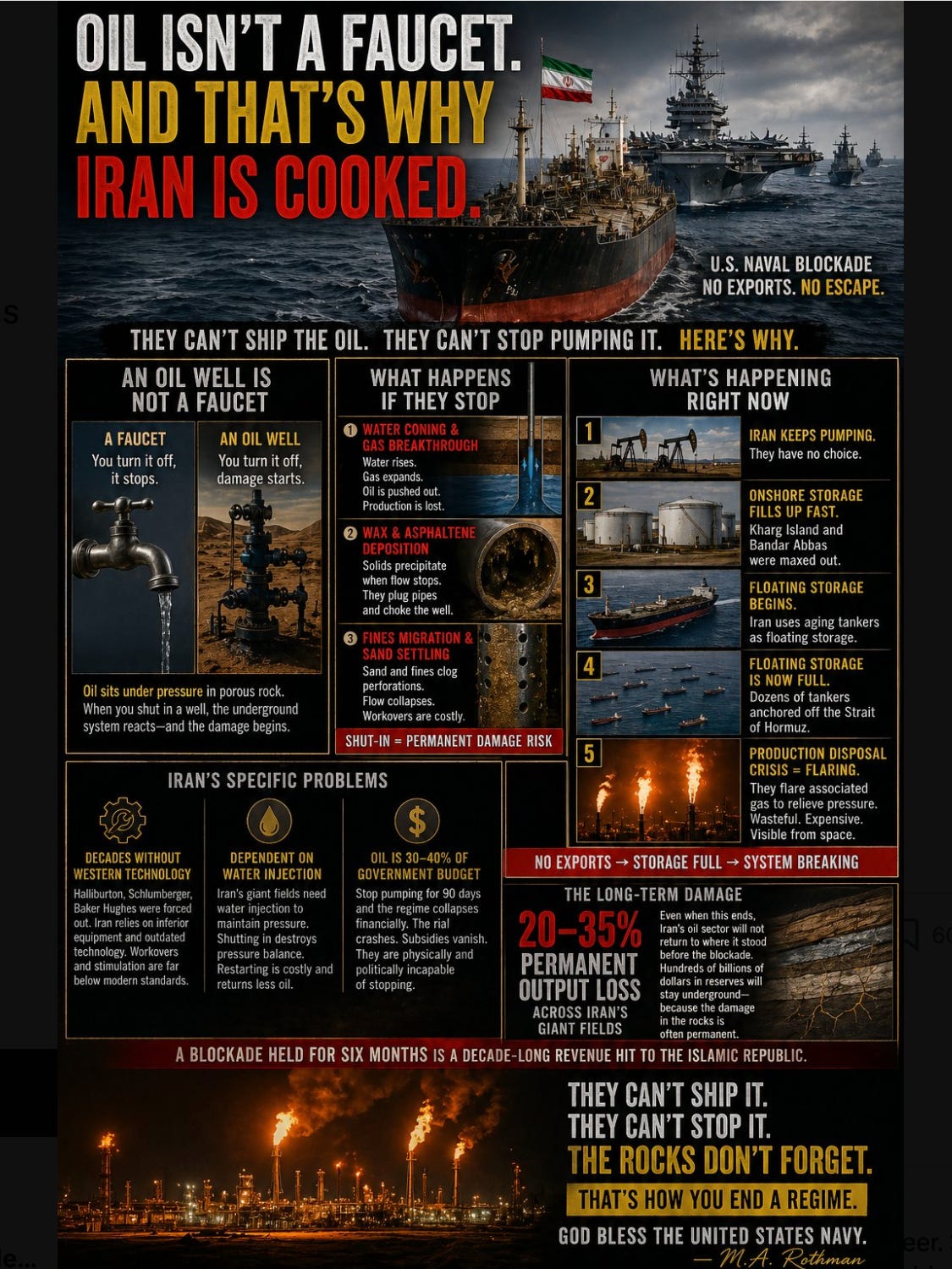
𝐀𝐧 𝐎𝐢𝐥 𝐖𝐞𝐥𝐥 𝐈𝐬 𝐍𝐨𝐭 𝐚 𝐅𝐚𝐮𝐜𝐞𝐭
A faucet has a valve. You close the valve, water stops, you open it, water flows. Same as before.
An oil well does not work that way at all.
An oil reservoir is a high-pressure system. Crude sits trapped in porous rock — typically sandstone or limestone — under pressure measured in thousands of pounds per square inch, mixed with natural gas above and saltwater below. When you drill into that rock, you are creating a controlled leak. The oil flows up the well because the underground pressure is pushing it.
When you shut the wellhead, the pressure does not stay still. It redistributes. Water from below pushes upward. Gas from above expands. The oil column gets disturbed — sometimes permanently. Petroleum engineers have a term for this: 𝐬𝐡𝐮𝐭-𝐢𝐧 𝐝𝐚𝐦𝐚𝐠𝐞.
𝐖𝐡𝐚𝐭 𝐀𝐜𝐭𝐮𝐚𝐥𝐥𝐲 𝐇𝐚𝐩𝐩𝐞𝐧𝐬 𝐖𝐡𝐞𝐧 𝐘𝐨𝐮 "𝐉𝐮𝐬𝐭 𝐓𝐮𝐫𝐧 𝐈𝐭 𝐎𝐟𝐟"
Three categories of damage start the moment you shut in a producing well.
The first is 𝐰𝐚𝐭𝐞𝐫 𝐜𝐨𝐧𝐢𝐧𝐠 𝐚𝐧𝐝 𝐠𝐚𝐬 𝐛𝐫𝐞𝐚𝐤𝐭𝐡𝐫𝐨𝐮𝐠𝐡. While the well is producing, the pressure drawdown holds the oil-water and oil-gas interfaces in roughly stable positions. Stop production, and water begins to rise into the producing zone while gas migrates downward. When you eventually restart, the well now produces salt water and natural gas instead of oil — sometimes permanently.
The second is 𝐰𝐚𝐱 𝐚𝐧𝐝 𝐚𝐬𝐩𝐡𝐚𝐥𝐭𝐞𝐧𝐞 𝐝𝐞𝐩𝐨𝐬𝐢𝐭𝐢𝐨𝐧. Crude oil contains paraffin waxes and heavy asphaltenes that stay liquid only because the oil is hot and moving. Stop the flow, and these solids precipitate inside the wellbore, the production tubing, and the surface flowlines. Restart attempts plug the well shut. Iranian crude is notoriously waxy.
The third is 𝐟𝐢𝐧𝐞𝐬 𝐦𝐢𝐠𝐫𝐚𝐭𝐢𝐨𝐧 𝐚𝐧𝐝 𝐬𝐚𝐧𝐝 𝐬𝐞𝐭𝐭𝐥𝐢𝐧𝐠. The perforations through the steel casing — the holes through which oil enters the well from the rock — clog with sand, fines, and asphaltene sludge during shut-in. Restart cuts flow rate, sometimes to zero, until a workover crew is deployed at six-figure cost per well to clean each one out.
For an old field — and Iran's giant fields are old: 𝐀𝐡𝐯𝐚𝐳, 𝐌𝐚𝐫𝐮𝐧, 𝐆𝐚𝐜𝐡𝐬𝐚𝐫𝐚𝐧, all producing since the 1950s and 60s — shut-in damage is brutal. Texas and Oklahoma operators in low-price periods routinely keep pumping at a loss rather than shut in, because the damage from shutting in costs more than the lost revenue.
𝐈𝐫𝐚𝐧'𝐬 𝐒𝐩𝐞𝐜𝐢𝐟𝐢𝐜 𝐏𝐫𝐨𝐛𝐥𝐞𝐦
There are three additional factors making Iran's situation worse than a typical producing nation's.
Decades of sanctions have starved the industry of Western technology. Halliburton, Schlumberger, and Baker Hughes were the global leaders in well stimulation, workover, and reservoir management until they were forced out of Iran between 2010 and 2018. The National Iranian Oil Company has limped along on Chinese-supplied equipment of significantly lower quality, plus reverse-engineered Russian and pre-revolution American gear. Restoration after a shut-in requires precisely the high-end services Iran no longer has.
Iran also depends on water injection to maintain reservoir pressure. Most of Iran's giant fields are on secondary recovery — meaning seawater is pumped down injection wells to push oil toward producers. Shut in the producers and you must also shut in the injectors, or the field over-pressurizes. Stopping injection lets pressure decline. Restarting injection costs hundreds of millions of dollars and typically returns the field to lower output than before. There is no clean reset button.
And oil is 𝟑𝟎-𝟒𝟎% 𝐨𝐟 𝐈𝐫𝐚𝐧'𝐬 𝐠𝐨𝐯𝐞𝐫𝐧𝐦𝐞𝐧𝐭 𝐛𝐮𝐝𝐠𝐞𝐭. Stop pumping for 90 days and the Iranian currency collapses, subsidies on bread and electricity vanish, and the regime faces a domestic crisis worse than the 2022 protests. They cannot stop. They are physically and politically incapable of stopping.
𝐖𝐡𝐚𝐭 𝐈𝐬 𝐀𝐜𝐭𝐮𝐚𝐥𝐥𝐲 𝐇𝐚𝐩𝐩𝐞𝐧𝐢𝐧𝐠 𝐑𝐢𝐠𝐡𝐭 𝐍𝐨𝐰
Iran continues pumping because it must. The U.S. blockade, which began February 28, prevents shipment.
Iranian onshore storage at Kharg Island and Bandar Abbas filled up within weeks. After that, the regime began using its own fleet of aging Very Large Crude Carriers as floating storage, anchored off the Strait of Hormuz with their AIS transponders dark.
The floating storage filled up next.
What happens then is what petroleum engineers call a 𝐩𝐫𝐨𝐝𝐮𝐜𝐭𝐢𝐨𝐧 𝐝𝐢𝐬𝐩𝐨𝐬𝐚𝐥 𝐜𝐫𝐢𝐬𝐢𝐬. Each pumping platform is producing oil that has nowhere to go — and gas associated with that oil that, if not flared, will over-pressurize the entire system. So Iran is now flaring increasing quantities of associated gas (visible from NASA VIIRS night satellite imagery), burning off the secondary product into the sky just to keep the primary product moving.
Flaring is wasteful, expensive, and visible from orbit. It is what countries do when they have run out of options.
𝐓𝐡𝐞 𝐋𝐨𝐧𝐠-𝐓𝐞𝐫𝐦 𝐃𝐚𝐦𝐚𝐠𝐞
Even when this war ends, Iran's oil sector will not return to where it stood on February 27, 2026.
A reservoir engineer can model the damage. Estimates range from 𝟐𝟎-𝟑𝟓% 𝐩𝐞𝐫𝐦𝐚𝐧𝐞𝐧𝐭 𝐩𝐫𝐨𝐝𝐮𝐜𝐭𝐢𝐯𝐢𝐭𝐲 𝐥𝐨𝐬𝐬 across Iran's giant fields, depending on how long the chaos continues and how badly the wells are mishandled while it is going on. That is hundreds of billions of dollars of reserves that will sit underground forever, because the regime did not have the technology, the time, or the strategic patience to manage a controlled shut-in properly.
This is what makes the U.S. naval blockade strategically devastating in a way that ordinary sanctions are not.
Sanctions reduce demand for Iranian oil. The blockade physically prevents its movement. And because Iranian oil cannot be turned off and cannot be shipped, every barrel pumped now becomes either flared waste or reservoir-damaging backpressure.
The Islamic Republic is not facing a financial squeeze. It is facing a 𝐠𝐞𝐨𝐥𝐨𝐠𝐢𝐜𝐚𝐥 𝐬𝐪𝐮𝐞𝐞𝐳𝐞 — the kind that does not get undone with a ceasefire, a sanctions waiver, or a billion-dollar Qatari escrow account.
It is the kind of damage that the rocks themselves remember.
𝐀 𝐛𝐥𝐨𝐜𝐤𝐚𝐝𝐞 𝐡𝐞𝐥𝐝 𝐟𝐨𝐫 𝐬𝐢𝐱 𝐦𝐨𝐧𝐭𝐡𝐬 𝐢𝐬 𝐚 𝐝𝐞𝐜𝐚𝐝𝐞-𝐥𝐨𝐧𝐠 𝐫𝐞𝐯𝐞𝐧𝐮𝐞 𝐡𝐢𝐭 𝐭𝐨 𝐭𝐡𝐞 𝐈𝐬𝐥𝐚𝐦𝐢𝐜 𝐑𝐞𝐩𝐮𝐛𝐥𝐢𝐜.
𝐆𝐨𝐝 𝐛𝐥𝐞𝐬𝐬 𝐭𝐡𝐞 𝐔𝐧𝐢𝐭𝐞𝐝 𝐒𝐭𝐚𝐭𝐞𝐬 𝐍𝐚𝐯𝐲
.