In the shadow of Egypt’s towering Sinai mountains, 275 miles south of Cairo, lies St. Catherine’s Monastery—a fortress of faith that has stood for centuries against the sands of time. Today, just 25 monks remain there, dedicating their lives to prayer, service, and the preservation of a Christian tradition that actually began in Egypt before spreading to the world.
This week on Breaking Battlegrounds, hosts Chuck Warren and Sam Stone sit down with Mariam Wahba, a research analyst at the Foundation for Defense of Democracies, to explore the monastery’s history, the power of monastic life, and the very real struggles Egypt’s Christians face today.
For Wahba, the story isn’t abstract—it’s personal. As a child, she made yearly pilgrimages to St. Catherine’s, experiencing firsthand the rhythms of monastic life: days built around prayer, community, and service. These monks, she explains, aren’t tucked away in solitude for the sake of escape; they’ve devoted their entire existence to faith and to sustaining a tradition that the Coptic Orthodox Church birthed centuries ago.
But while St. Catherine’s continues to endure, Christianity in Egypt faces a different kind of test. Repairing churches requires a government permit, and many requests have been stalled or outright denied. For a community already living on the margins, this red tape isn’t just bureaucracy—it’s an obstacle to survival.
Chuck and Sam also raise a fascinating historical “what if”: monasteries weren’t always just spiritual centers. In the early centuries of Christianity, they were also economic engines, spreading technology, knowledge, and trade across the globe. When the Catholic Church moved away from that model, did it cut off one of history’s most powerful networks of innovation?
The discussion is a reminder that monasteries, though cloistered, were once deeply connected to the world around them—and perhaps we’ve underestimated their role in shaping civilization itself.
This conversation with Mariam Wahba isn’t just about faith—it’s about resilience, heritage, and the delicate balance between preserving tradition and navigating the realities of modern politics. In a world where stories of Middle Eastern Christians are rarely told, this episode pulls back the curtain on one of history’s oldest communities still fighting to be seen.
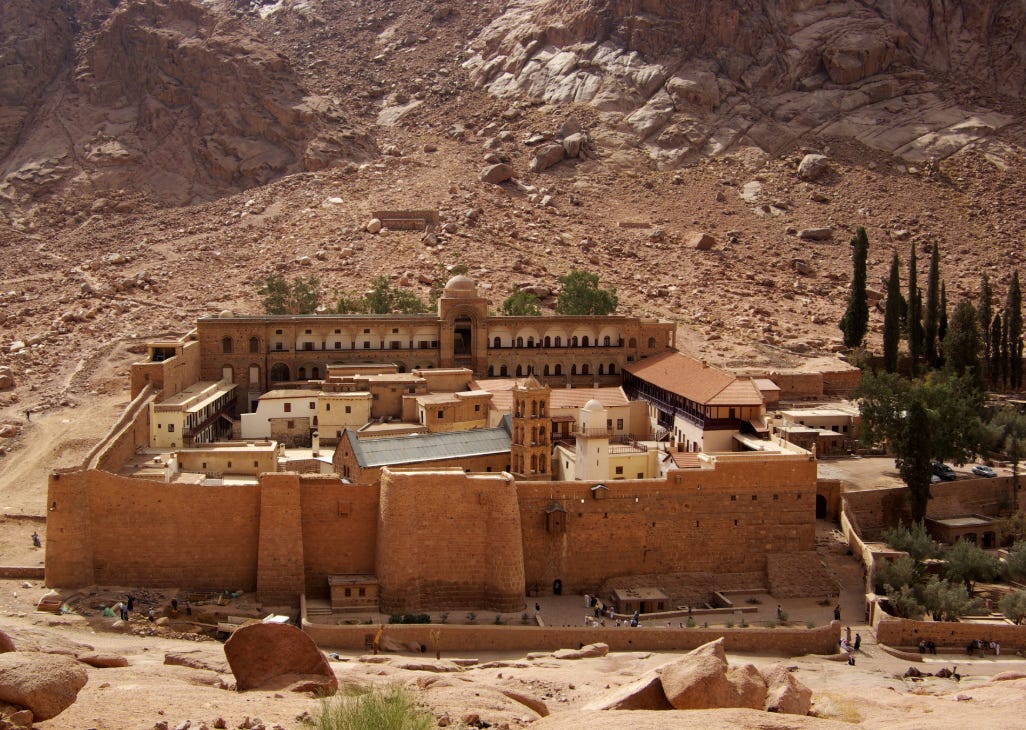
St. Catherine's Monastery
Transcript
**Chuck Warren: **So I want to talk a little bit more about St. Catherine's Monastery. So it's about 275 miles south of Cairo. There's 25 monks that live there today, okay? What exactly do the monks do all day? I understand as a child you would make a pilgrimage there once a year. Tell us a little bit about that experience and also tell us about what Egypt's doing about repairing Christian churches. I guess you have to have a permit and there's a bunch of, you know, there's a bunch of requests out and they're not giving the permits.
**Mariam Wahba: **Absolutely let me actually take a step back and and talk about monasticism, the practice of monk or or holy ordained people traveling far into the desert to dedicate their life to their faith. And it is actually an interesting story because it begins in the Coptic church. Monasticism was created by the Coptic Orthodox church way back in the day. And you know it was exported to the rest of the Christian world.
And it's a practice that continues to this very day. And when you asked the question of what do the monk do all day that is uh... a really interesting question to me because you know I can't tell you anecdotally uh... but I can tell you from first-hand account and obviously having grown up around the monastery and visiting frequently. I mean these are people who have dedicated their whole lives to the church and serving their communities and these monks do just that day in and day out. And these are what the twenty five greek monks do everyday.
**Sam Stone: **You know, I don't know that much about the current operation and approach to monasteries, but I know a fair bit about its ancient traditions. One of the things I wonder, Chuck and Mariam, I'll throw this kind of curveball out there, but when the Catholic Church and the various Catholic Christian sects went away from having their monasteries be a network for economic development, I wonder if that was a giant historical mistake.
Because these were monasteries across the world were one of the great economic networks from a few hundred years after the birth of Christ until a few hundred years ago. I mean, every one of them had to produce more than the income needed to maintain itself, but they brought technology and all sorts of things across the globe by doing so.
Listen to the full episode of Breaking Battlegrounds anywhere you stream your podcasts!